The Thirteenth Demon
♪♫ I wanna love you, but something's pulling me away from you. Jesus is my virtue. And Judas is the demon I cling to. ♪♫ – Lady Gaga, “Judas”
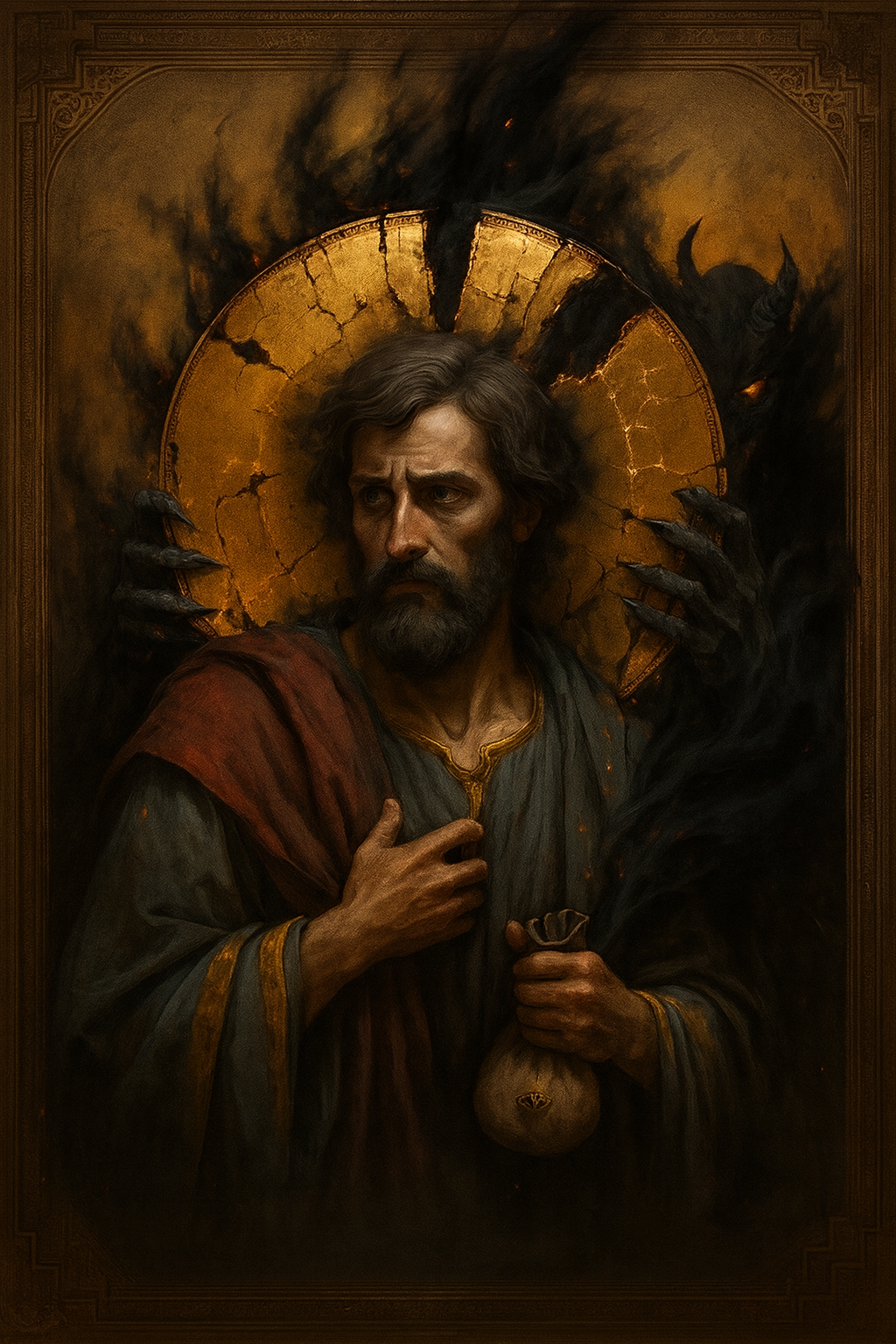
Judas Iscariot, perhaps one of the most villainized names in history, known for betraying Jesus Christ for thirty pieces of silver. After said betrayal, he ultimately dies and comes to be associated with treachery and his mention anathema.
There’s a common trait that all villains share 100% across the board, that is to say, they’re never the bad guys in their stories. They have motives, wants, fears, just as valid to them as any hero’s tale.
As a young adult, I wondered what Judas’s story was. He saw the miracles performed by Jesus, he had to know he was the real deal. Thus must the consequences also be real. Why would he, in any sane reality, betray this claimed son of god?
It didn’t make sense, and I thought it was just a piece of the puzzle I wasn’t going to get to understand until I got to heaven and got to ask questions and talk to people that had been there. But I was determined to learn as much about Judas as I could with the only real resource I had – the infallible word of god.
In the book of Matthew and Acts were the most details I found on the betrayer. But sometimes what I was reading wasn’t making sense, much like Judas’s missing side of the story. I was told that Judas hung himself after betraying Jesus. But later I read that he fell down a la Humpty Dumpty and all his guts spilled out and soaked the fields in blood.
I asked about the inconsistency, and got a lot of different answers. “Oh, he hung himself and the rope snapped, then his guts fell out.” Was one answer I’d received. “It is not our place to question.” Was another frequent infuriating answer within faith. Shouldn’t the story be consistent? All the stories I’d ever read had been.
Today, I want to prepare a table for your reflection. It lists inconsistencies pertaining to the man critical to the betrayal of Christ.
Two Sides to Every Story
| Contradiction Title | Question | Matthew | Acts |
|---|---|---|---|
| Contradiction Mori | How did Judas die? | He hangs himself. | He falls and bursts open. |
| Contradiction of Akeldama | Who bought the Potter’s Field / Field of Blood? | The priests buy the field because the 30 silver is blood money. | Judas buys himself the field — treat yo’self. |
| Contradiction In Nomine | Why was it named the Field of Blood? | It’s called Field of Blood because it was purchased with blood money. | It’s called Field of Blood because of the literal blood from Judas’ corpse. |
| Contradiction In Mortis | If one looked upon Judas, what would they see? | A hung man. | A graphic bodily explosion. |
| Contradiction of Remorse | Was Judas sorry for what he did? | Yes — he feels remorse and kills himself over it. | Not mentioned. Judas is dealt with, seems to suffer divine justice, and is presented as a cautionary tale. |
Just as the writer of any article (even these) has an angle, a preference, we must look at what angle Matthew and Acts are leaning into. For Matthew, we see prophecy being fulfilled by Judas betraying Jesus for 30 pieces of Silver. We see him hang himself in remorse. For Acts, we see divine retribution. One tale inspires hope, one tale inspires fear. But why did Judas deserve what he got?
In every story, there must be a villain. A balance of the inferred ‘other’. Otherwise, the story doesn’t get read as there is no plot or tension. In god’s story, he needed someone to betray his son in order to make good on jesus fulfilling every prophecy ever made. If there was no betrayer, jesus wouldn’t fulfil one of the prophecies and thus no true messiah. So I think its fair to conclude Jesus had to be betrayed. And if Jesus must be betrayed, someone must be that betrayer. Someone had to fulfil the role. Someone was created to suffer for eternity just because god couldn’t write a well developed story.
Evil is not always chosen, somtimes it is assigned. Judas had no choice in his fate and is yet another sacrificial lamb in a long line of spilled blood. Judas did what was ordained for him to do, and his obedience, if one believes in Christianity, rewarded him with an eternity separated from the love of god. Judas lived for roughly 30 years, and will now suffer until the end of all things. An infinite punishment for the limited understanding that 30 years of life grants (Not to mention, he was possessed by Satan per the bible!)
Very recently I came across the Gospel of Judas, and what I read within it was thought provoking. I still do not know if it is to be believed as valid, because like many treatises of the time, anyone could be “Matthew” if they knew how to write. There is a phrase in Latin which is Nullius In Verba – it means “On the word of no one.” For many Ex-Christians, we took the word of anyone, and that is where we got caught. Read the Gospel here, it is a quick read. I’ll wait here while you read over it. Thank you to Gospels.Net for this file.
*Polite pause*
Welcome back! The story we have now both read gave me many questions on the thirteenth demon. What the heck was Barbelo? Why were the disciples such dicks (Remember, they hated Mary Magdalene, read her Gospel too!) And …did my eyes deceive me? Another entity predestined to rule over a kingdom he didn’t want? It showed me that if this gospel was true, it establishes that God has no problem using the same tricks on multiple vectors of his divine plan. Satan gets to rule hell, Judas gets whatever the hell void-sphere this is. Keep questioning, because I’m not sure what to think yet myself.
As I close, reflect on this simple possibility.
All it would have taken is one cosmic condition to be different, and you could have been Judas Iscariot.
I want you to be still, and dwell on that for a moment.
You would not be able to change your mind. You would betray your Jesus, and your reward for your obedience to the plan is damnation. People would revile your name for centuries. You would be associated with treachery, untrustworthiness, and scorn for as long as this fable grips the world.
A faith that claims it has infallible words of god. A faith that claims god’s elect were chosen to write his message. A faith that cannot coherently explain the final moments of a man essential to its central event.
God’s elect were chosen. Were they chosen like Judas? Chosen like Lucifer? Like Pharoah? They thought they had control of their minds, bodies, and souls. Surely, they thought so with just as much certainty as you believe in your own faculties right now. Are you fortunate enough to be one of the chosen?
You’ve stared at your personal Jesus, now face down your inner Judas.
Questions for consideration:
What would the Early Church have to gain from presenting conflicting stories that depict divine retribution and fulfilment of prophecy?
If Crucifixion was god’s plan, why does one instrumental to its arrival suffer damnation?
How do you know you're in control right now?
© 2025 – Present. Sympathy for Samael. All rights reserved.